
For millennia, traditional Asian medicine systems have revered fungi not merely as nutritional sustenance, but as potent biological response modifiers. Today, modern oncology and integrative medical science are validating what ancient practitioners knew intuitively: medicinal mushrooms harbor sophisticated chemical architectures capable of modulating the immune system, alleviating systemic inflammation, mitigating cancer therapy side effects, and promoting neurological regeneration.
In my clinical practice as an integrative oncologist, the discussion surrounding medicinal fungi has shifted from fringe alternative wellness to evidence-informed supportive care. When integrated thoughtfully alongside standard treatments—such as chemotherapy, radiation, and immunotherapy—specific medicinal mushrooms serve as powerful biochemical allies, enhancing host resilience without compromising therapeutic efficacy.
The Biochemical Machinery: How Medicinal Mushrooms Work
The therapeutic versatility of medicinal mushrooms stems from a rich matrix of bioactive compounds residing within their cell walls and mycelial networks. Understanding these mechanisms is crucial for utilizing them effectively in clinical settings:
- Beta-Glucans (1,3-1,6-D-glucans): Polysaccharides found in cell walls interact directly with cell surface receptors on innate immune cells (such as macrophages, natural killer cells, and dendritic cells), triggering enhanced surveillance and pathogen recognition.
- Triterpenes & Sterols: Terpenoid compounds found abundantly in species like Reishi demonstrate marked anti-inflammatory, hepatoprotective, and tumor-inhibiting properties by downregulating nuclear factor-kappa B (NF-κB) pathways.
- Antioxidants & Micronutrients: Essential trace minerals such as selenium, coupled with fungal enzymes like superoxide dismutase (SOD), neutralize oxidative stress and shield cellular DNA from free radical damage.
Key Medicinal Mushrooms in Clinical Practice
While dozens of species exhibit health benefits, five primary fungi stand out for their robust body of modern scientific research and therapeutic relevance:
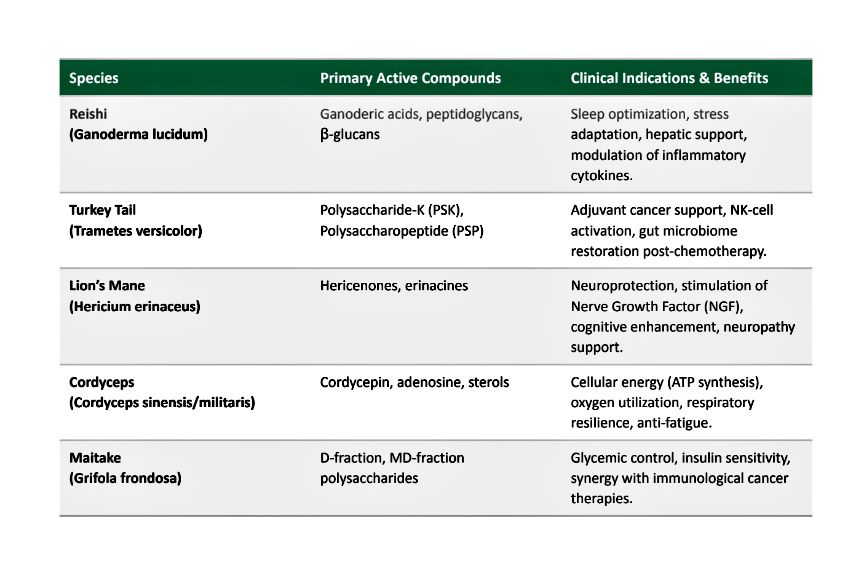
Applications in Integrative Oncology
In oncology, medicinal mushrooms are utilized as complementary agents to protect healthy tissue, restore white blood cell populations, and reduce treatment-related toxicities without interfering with cytocidal radiation or chemotherapy agents.
Immune Restitution and White Blood Cell Preservation
Chemotherapy-induced myelosuppression (neutropenia and leukopenia) leaves patients vulnerable to life-threatening infections. Extract fractions such as Turkey Tail’s PSK have demonstrated in clinical trials the ability to stimulate bone marrow progenitor cells and maintain active natural killer (NK) cell populations throughout intensive treatment cycles.
Mitigating Chemo-Brain and Chemotherapy-Induced Peripheral Neuropathy (CIPN)
Central nervous system neuroinflammation and peripheral nerve degeneration are frequent side effects of platinum-based chemotherapy agents. Lion’s Mane (Hericium erinaceus) promotes the expression of Nerve Growth Factor (NGF) and myelin sheath repair, providing a neuroprotective shield that reduces brain fog, paresthesia, and peripheral pain.
Sourcing, Extraction, and Clinical Safety
Not all mushroom products are created equal. Achieving clinical efficacy requires attention to processing techniques, dosage forms, and potential contraindications:
- Hot-Water & Dual Extraction: Standard raw mushroom powder is composed largely of indigestible chitin. Dual-extraction (using hot water and alcohol) is mandatory to break down chitin and extract both water-soluble beta-glucans and alcohol-soluble triterpenes.
- Fruiting Body vs. Mycelium: Ensure products are derived from whole fruiting bodies rather than grain-grown mycelium, which often contains high concentrations of starch fillers.
- Organic Sourcing & Testing: Fungi are bio-accumulators that readily absorb heavy metals and environmental toxins. Always verify third-party testing for purity.
- Drug Interactions & Surgery: Certain species (e.g., Reishi) possess mild anti-platelet activity and should be monitored or temporarily discontinued prior to major surgical procedures.
Embracing Fungal Medicine in Modern Healthcare
As integrative oncology continues to evolve, medicinal mushrooms represent a harmonious bridge between ancient botanical medicine and contemporary scientific research. By incorporating high-quality, standardized fungal extracts into individualized patient protocols, we can significantly enhance resilience, preserve quality of life, and optimize therapeutic outcomes.



Leave a Reply